
















Greater Safety in Ongoing Operations
Especially with pressure vessel testing or machine maintenance: Those who see early what's changing can act in time.
Knowing what is happening in a space you cannot directly observe is one of the oldest practical challenges in security work. Whether the context is protecting a property, verifying conditions inside a sealed enclosure, or conducting a careful reconnaissance of a site before entry, the quality of your visual information shapes every decision that follows. Reconnaissance, in its broadest sense, means gathering information about a place or situation before acting on it, and that principle applies as much to a facility manager checking a confined space as to a security professional assessing an unfamiliar environment.
The surveillance meaning most people reach for involves cameras and monitoring, but effective surveillance also depends on the tools used to gather that imagery. A standard camera placed in an open position tells you one thing; an inspection device that can reach into a wall cavity, a pipe run, or a sealed housing tells you something far more precise. EVi Scopes develops video endoscopes and rigid borescopes built for exactly that kind of close-range, high-resolution visual access. Understanding what clandestine means in a security context, where clandestine refers to activity carried out in a concealed or secretive manner, helps clarify why the ability to inspect without disturbing a surface or alerting a subject matters so much. The right optics give you answers without announcing the question.
Most conventional cameras are designed for open, well-lit environments. Point one at a dark corridor or a sealed enclosure and the image degrades quickly. Lighting conditions, physical access, and the geometry of the space all work against you. A pinhole or wide-angle lens mounted on a wall captures what happens in front of it, but tells you nothing about what is inside a duct, behind a panel, or within a pipe that runs beneath the floor. That gap between what a standard camera sees and what a security inspection actually requires is where many assessments run into trouble.

Confined spaces, complex pipe networks, and sealed housings demand tools shaped for their geometry. A rigid borescope or articulating video endoscope can travel into those spaces and return clear, detailed imagery without destructive access. Lighting matters equally: many cavities are completely dark, and a built-in illumination source determines whether the image is usable at all. At EVi Scopes, the available options include white light and ultraviolet illumination for fluorescent trace detection, so the right tool matches the inspection from the outset. Choosing poorly at this stage means re-entering the space, losing time, and potentially missing evidence that was only visible once.


EVi Scopes produces a range of video endoscopes and rigid borescopes suited to security and surveillance inspection tasks. The EVi 5, EVi 5.7, and EVi 6 series cover a broad spread of probe diameters and lengths, with illumination options including white light, infrared, and UV at 365 nm. For pipe and channel inspection, the EVi R series adds dedicated push-rod camera capability. Where access geometry demands a telescoping reach, the EVi TM series extends that range further.
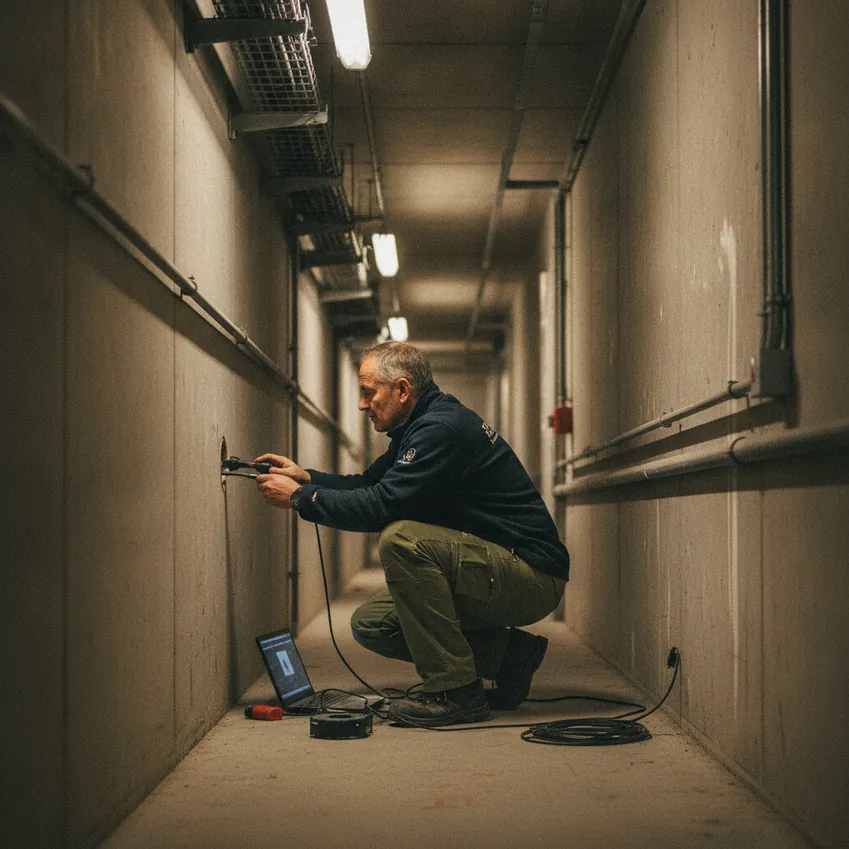
Visible light only reveals so much. In security and forensic inspection contexts, ultraviolet illumination at 365 nm activates fluorescent compounds that remain completely invisible under white light, including certain residues, biological traces, and marker fluids used in asset protection. Infrared illumination, by contrast, penetrates surface conditions that scatter or absorb visible wavelengths, making it useful when a cavity contains dust, condensation, or light contamination. Understanding how night vision works helps here: most passive night-vision systems amplify ambient light, while active infrared systems project their own illumination and capture the reflected signal, giving usable imagery in total darkness.
EVi Scopes builds these illumination modes directly into its endoscope series rather than treating them as afterthoughts. The EVi 5 ZUV, EVi 5.7 ZT UV, and EVi 6 ZT UV variants carry UV capability; the corresponding IR variants handle infrared inspection. That means you select the probe for the geometry of the space and the illumination for the nature of what you are looking for, without needing separate lighting rigs or adapters. For security professionals who need to document findings, the devices capture both still images and video, giving you a verifiable record of what the inspection revealed and when.

Effective surveillance work depends as much on legal awareness as on technical capability. The surveillance meaning in law is narrower than in everyday speech: many jurisdictions draw a firm line between monitoring your own property and conducting directed observation of another person. In the UK, the Regulation of Investigatory Powers Act sets out who may lawfully conduct covert observation and under what conditions, with private individuals holding limited authority. In the United States, the picture varies by state, and the concept of two-party consent states is particularly relevant to anyone considering audio recording: in those states, all parties to a conversation must consent before a recording is lawful, even on your own premises. GPS vehicle tracking follows a similar logic. Tracking a vehicle you own is generally permissible, but attaching a device to someone else's car without consent crosses into illegal territory in most English-speaking jurisdictions. Before deploying any tool from the EVi Scopes range in a security context, confirming the legal framework that applies to your specific situation is essential. Technical capability to see something does not automatically confer the right to look.
Whether industrial endoscope, uv inspection light or camera system – we deliver what you need for your visual inspection. Tailored to your needs. Direct, robust, reliable. Get expert advice now. We help you select and properly apply your inspection technology.
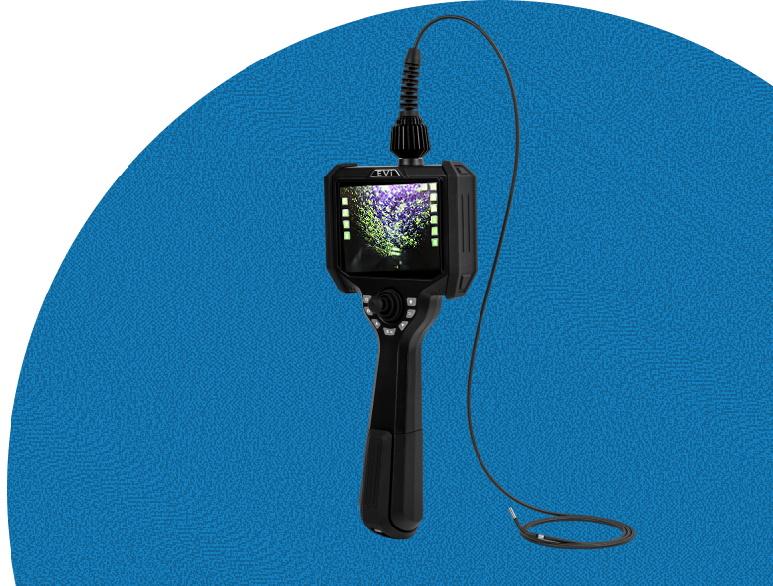
A well-structured security inspection follows a repeatable sequence that keeps findings defensible and the process efficient. You begin by identifying the access point and selecting the probe diameter and length that fits the geometry of the space, since forcing an oversized instrument risks damaging the surface and alerting anyone who later examines it. Once the probe is positioned, you set the illumination mode appropriate to what you expect to find: white light for general visual assessment, UV for trace detection, infrared for low-light or contaminated cavities. The device records continuously or on demand, and the resulting footage carries a timestamp that anchors the evidence to a specific moment. After withdrawal, you review the footage on the integrated display or export it for analysis, checking for anomalies that a live pass might have moved through too quickly to register. Where a second pass is needed, the same probe re-enters without any surface preparation, keeping the inspection genuinely non-destructive. That combination of precise access, selectable illumination, and documented output is what separates a professional inspection from an improvised one, and it is the standard EVi Scopes equipment is built to support.

More than just a clear view
Especially with pressure vessel testing or machine maintenance: Those who see early what's changing can act in time.
No paper chaos, no follow-up submissions – results can be saved, traced and presented directly. Especially important for proof to authorities or customers.
In quality assurance, the difference between “looks good” and “is flawless” sometimes makes all the difference. Good images help with decision-making.
When multiple people inspect together – live or with saved images – decisions can be made faster and clearer. That saves time and nerves.
FAQ
Because many people are interested: Here you will find practical answers to frequently asked questions about our product portfolio and our services – explained in an understandable way, directly from practical experience.
Questions? We are happy to help.Clandestine describes activity carried out in a concealed or secretive manner to avoid detection. In inspection work, it refers to accessing a space or gathering imagery without disturbing surfaces or signalling that an assessment has taken place, keeping the findings uncontaminated by the act of looking.
In everyday speech, surveillance covers any form of monitoring. Legally, it often refers specifically to directed observation of a person, which many jurisdictions regulate strictly. Monitoring your own property generally falls outside those restrictions, but the rules vary by country and context.
Active infrared systems project their own infrared light into a dark space and capture the reflected signal with a sensor tuned to that wavelength. Unlike passive night vision, which amplifies ambient light, active infrared works in total darkness and is built directly into EVi Scopes IR-variant probes.
Two-party consent states require all parties to a conversation to agree before any audio recording is lawful, even on private property. If you plan to monitor a space where conversations may be captured, you need to confirm whether your state or jurisdiction applies this rule before recording begins.
The EVi 5 and EVi 5.7 series offer slim probe diameters suited to tight cavity access, with lengths configurable for wall and ceiling runs. White-light, UV, and infrared variants are available within those series, so you can match illumination to the specific detection task.
Yes. UV illumination at 365 nm excites fluorescent compounds that absorb that wavelength and re-emit visible light, making them clearly visible on camera. Biological traces, certain residues, and asset-marking fluids commonly used in security applications respond strongly to this wavelength and remain invisible under white light.
Reconnaissance means gathering information about a location or situation before taking action. In facility security, it describes the pre-entry assessment of a confined space, pipe network, or sealed enclosure to identify hazards, verify conditions, or locate anomalies before a team commits to physical access.
Inspecting a space you own with a video endoscope is generally lawful, provided you are not capturing audio without consent in a two-party consent jurisdiction and are not directing the device at a person in a way that constitutes unlawful surveillance. Confirming the rules in your specific jurisdiction before starting is always advisable.
Infrared illumination projects light beyond the visible spectrum to penetrate dust, condensation, and light surface contamination, returning a usable image in conditions where white light scatters. UV at 365 nm serves a different purpose: it activates fluorescent traces rather than cutting through obscuring material, making the two modes complementary rather than interchangeable.
Storage formats depend on the specific device model. EVi Scopes endoscopes typically save still images as JPEG files and video as MP4, with timestamps embedded in the file metadata. For precise format details relevant to your model, contacting EVi Scopes directly at support@eviscopes.com gives you the most accurate answer.