

















Greater Safety in Ongoing Operations
Especially with pressure vessel testing or machine maintenance: Those who see early what's changing can act in time.

Both the food and pharmaceutical industries share a fundamental obligation: what reaches the consumer must be safe, uncontaminated, and exactly as specified. That obligation translates into relentless inspection pressure at every stage of production. A food safety audit does not end at paperwork; it requires physical evidence that surfaces, seals, and enclosed spaces meet hygiene standards. In pharmaceutical manufacturing, pharmaceutical quality control goes further still, demanding that every vial, ampoule, and container closure holds its integrity before a product ever leaves the facility.
What makes these industries particularly demanding for inspection is the combination of tight access geometry and zero tolerance for defects. Mixing vessels, filling lines, fermentation tanks, and cleanroom pipework all contain internal surfaces that are impossible to assess with the naked eye from outside. The same applies to the inspection of packaging components, where even a hairline crack in a container seal can compromise sterility. Visual inspection tools built for general maintenance simply lack the resolution and illumination control that regulated environments require. You need instruments that produce documented, reproducible image evidence, because regulators and quality managers alike will ask to see it. That is the gap that EVi Scopes purpose-built video endoscopes and borescopes fill in both sectors, turning inaccessible cavities into fully auditable inspection zones.
Regulated production environments create inspection challenges that general-purpose tools were never designed to solve. Filling lines for injectable products run through narrow, enclosed channels where contamination risks are highest and visibility is lowest. Fermentation vessels used in both probiotic food production and biologics manufacturing develop internal deposits that standard borescopes cannot resolve clearly enough for a quality record. Container closure integrity testing requires close examination of seal geometry that demands stable, high-resolution imaging rather than a quick visual pass. When an auditor or quality manager requests documented evidence of an internal surface condition, a blurred still image taken with an inadequate tool is not an acceptable answer.

The supply chain connecting both industries adds real complexity. Food-grade excipients such as starches, gelatins, and lecithins move directly into pharmaceutical manufacturing as binders and capsule materials. Shared cold chain infrastructure means inspection standards from one sector increasingly influence the other. Vial inspection protocols developed for injectables now inform how food packaging integrity is assessed, because the underlying risk logic is identical: a compromised seal means a compromised product. EVi Scopes builds inspection tools that satisfy pharmaceutical-grade documentation requirements, which means they carry direct value on the food production side as well.


Choosing the right tool for a regulated environment means matching probe diameter, working length, and illumination type to the specific inspection task. EVi Scopes offers video endoscopes across the EVi 5, EVi 5.7, and EVi 6 series alongside rigid borescopes in the EVi BS and EVi SD lines, covering the full range of access geometries found in food processing and pharmaceutical manufacturing. UV illumination variants operating at 365 nm support fluorescent residue detection, while white-light and infrared options address surface condition and thermal assessment tasks.
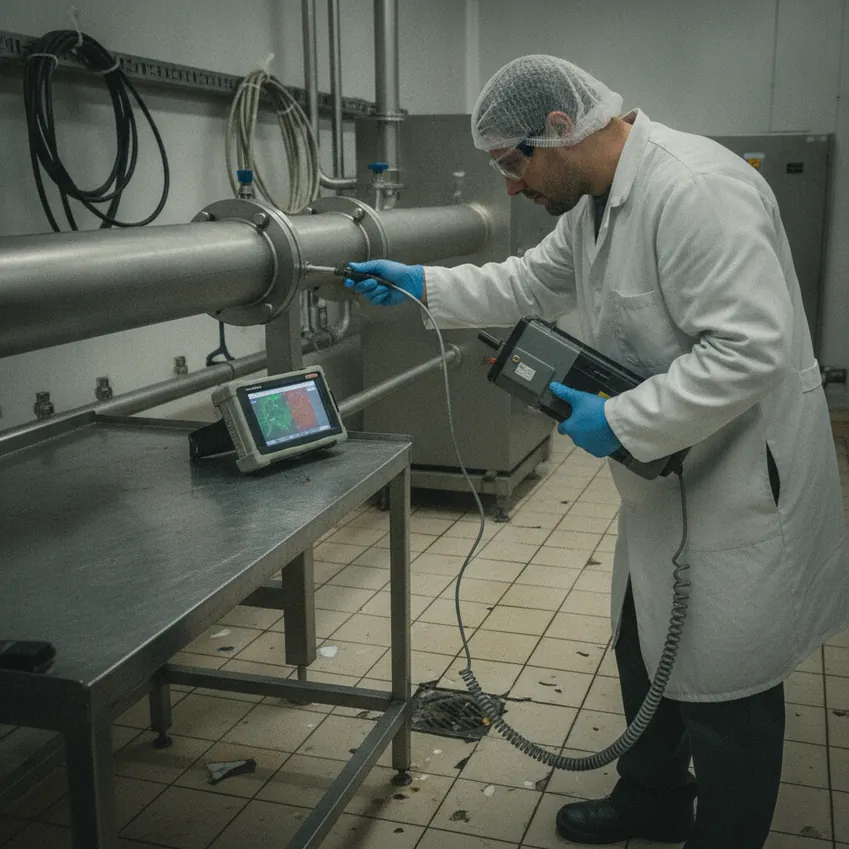
Instrument design matters as much as image quality when you work inside a regulated facility. Probes that cannot be reliably cleaned and decontaminated between inspections introduce contamination risk at the point you are trying to eliminate it. The EVi series uses smooth, sealed probe construction that withstands the cleaning protocols common in food and pharmaceutical environments. Articulating tips on the video endoscope models let you steer around bends inside filling equipment and tank internals without forcing the probe, which protects both the instrument and the surface under inspection.
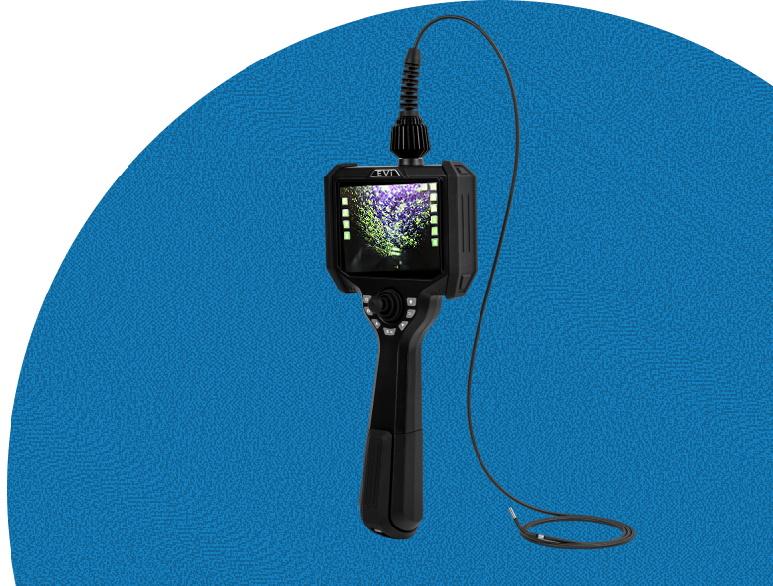
Beyond the physical probe, the ability to capture still images and video directly from the handset changes how inspection findings are recorded. When a visual inspection machine for injectable products flags a suspect container, the follow-up manual inspection needs to produce evidence that is timestamped, clear, and retrievable. EVi Scopes instruments record directly to the device, giving quality teams a documented inspection trail without relying on external cameras or secondary recording equipment. For a food safety audit, the same capability means that internal surface conditions inside mixing vessels or heat exchangers can be photographed and filed as part of the audit record. The EViSH high-resolution probe with its integrated touch display allows on-the-spot review and annotation before the inspector leaves the production floor. That combination of image quality, probe maneuverability, and built-in documentation closes the gap between what you observe and what you can prove.

Few people outside these industries appreciate how deeply food and pharmaceutical manufacturing are intertwined at the process level. Fermentation vessels used for probiotic yogurt and for biologics such as insulin share the same curved internal walls, agitator shafts, spray nozzles, and outlet valves that accumulate residue. EVi Scopes inspection cameras are built to reach all of these geometries without dismantling equipment. Food-grade excipients including starches, gelatins, and lecithins travel directly from food processing facilities into pharmaceutical plants, where they serve as tablet binders, capsule shells, and coating agents. Any contamination event in the upstream food supply chain can propagate into a pharmaceutical product, which is why quality teams in both sectors apply the same rigorous internal inspection standards. Cold chain infrastructure adds a further dimension: shared refrigerated storage and transport systems mean that a seal failure in a vaccine shipment and a compromised dairy container are assessed using the same container closure integrity logic. A camera system that satisfies pharmaceutical documentation requirements will almost certainly exceed what a food safety audit demands, making a single inspection tool practical across both environments.
Whether industrial endoscope, uv inspection light or camera system – we deliver what you need for your visual inspection. Tailored to your needs. Direct, robust, reliable. Get expert advice now. We help you select and properly apply your inspection technology.
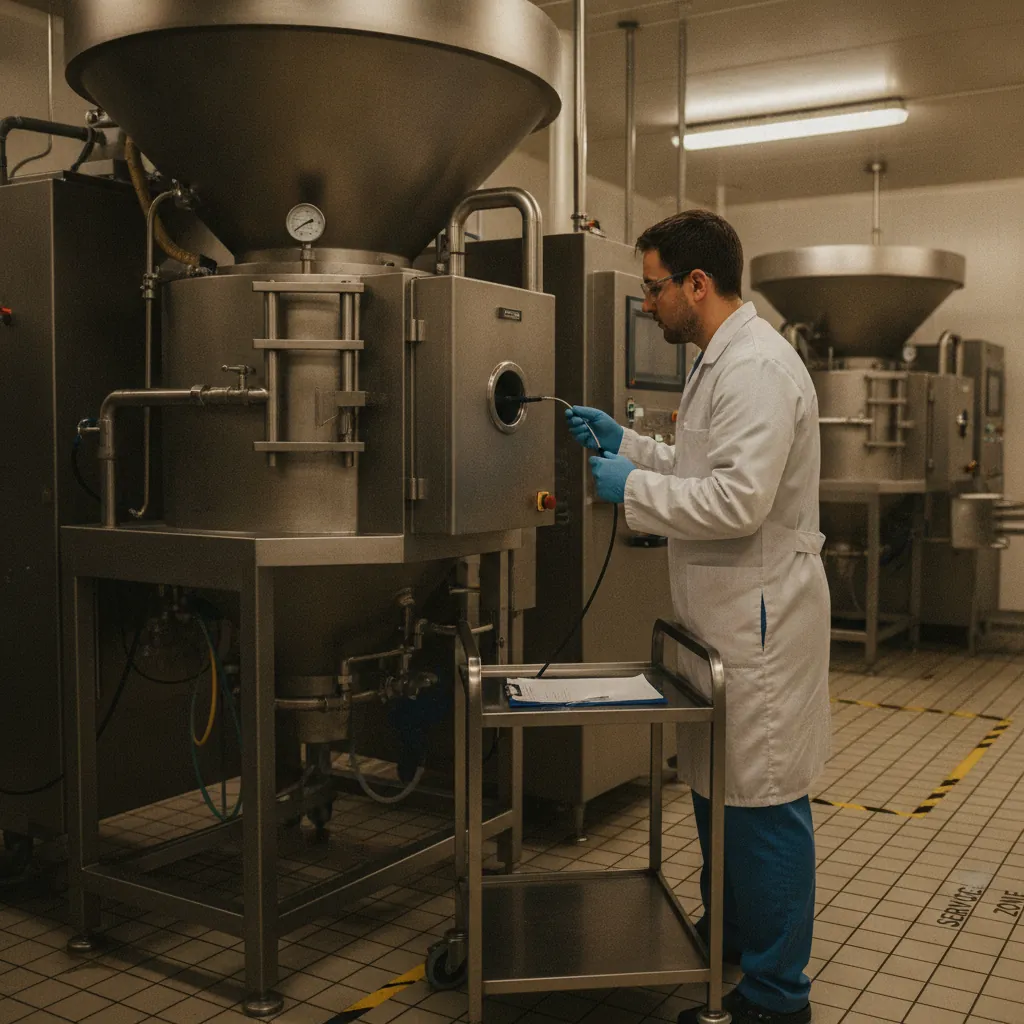
Putting an endoscope to work in a food or pharmaceutical facility follows a clear sequence that fits within existing quality workflows. You begin by selecting the probe diameter and working length suited to the access point, whether that is a narrow port on a filling line or a wider entry on a fermentation vessel. The articulating tip is adjusted before insertion so that the camera faces the surface of interest as soon as it enters the cavity. Once inside, white-light illumination reveals surface deposits, corrosion, or mechanical damage, while switching to the UV variant at 365 nm activates any fluorescent penetrant or residue present, making contamination visible that white light would miss.
Still images and video are captured directly on the handset throughout the inspection, each frame automatically associated with the session record. After withdrawal, the probe is cleaned according to the facility's decontamination protocol, and the recorded media transfers into the quality management system. For container closure integrity testing or vial inspection follow-up, an EVi Scopes rigid borescope or high-resolution EVi SD probe examines the seal geometry and closure surface, producing image evidence that supports or challenges the automated inspection result. The entire process integrates into an audit trail without requiring additional photography equipment or manual transcription of findings.
More than just a clear view
Especially with pressure vessel testing or machine maintenance: Those who see early what's changing can act in time.
No paper chaos, no follow-up submissions – results can be saved, traced and presented directly. Especially important for proof to authorities or customers.
In quality assurance, the difference between “looks good” and “is flawless” sometimes makes all the difference. Good images help with decision-making.
When multiple people inspect together – live or with saved images – decisions can be made faster and clearer. That saves time and nerves.
FAQ
Because many people are interested: Here you will find practical answers to frequently asked questions about our product portfolio and our services – explained in an understandable way, directly from practical experience.
Questions? We are happy to help.The EVi 5 and EVi 5.7 series, with probe diameters of 5 mm and 5.7 mm respectively, suit the narrow access ports typical of pharmaceutical filling equipment. For wider vessel entries, the EVi 6 or EVi 8.0 series provides greater image coverage without sacrificing resolution.
Yes. After an automated system flags a suspect container, a rigid EVi BS borescope or the EVi SD probe can examine the seal geometry and closure surface directly, producing still images and video that either confirm or challenge the automated result as part of your documented quality record.
UV illumination at 365 nm activates fluorescent residues, cleaning agents, and biological deposits that white light leaves invisible. Inside a mixing vessel, this reveals residue patterns along welds, agitator shafts, and outlet valves that a standard visual pass would miss entirely.
EVi Scopes probes use sealed, smooth-surface construction compatible with the wipe-down and chemical decontamination protocols standard in food and pharmaceutical cleanrooms. Always verify compatibility with your facility's specific cleaning agents before first use in a regulated environment.
Yes. The EVi SD and EVi BS rigid probes provide the stable, high-resolution close-up imaging needed to assess vial seal geometry and surface condition after an automated flag. The image is captured directly on the handset and filed without secondary equipment.
EVi Scopes instruments record still images and video directly to the handset, timestamped within the session. Quality teams transfer these files into their quality management system, creating a retrievable inspection trail that satisfies GMP documentation requirements without manual transcription.
The probe construction and decontamination compatibility make cross-sector use practical, provided the cleaning protocol between environments is followed. Many quality teams use the same instrument series across fermentation vessel inspection in food production and bioreactor checks in pharmaceutical manufacturing.
Working lengths vary across the EVi series and the rigid EVi BS and EVi SD lines, covering short-reach tasks inside packaging components up to extended reaches inside large fermentation or storage vessels. Contact EVi Scopes directly to match working length to your specific access requirement.
Yes. EVi Scopes offers the Series S custom configurations for non-standard probe diameters, lengths, and illumination combinations. These are developed in direct consultation with the customer to address access geometries that standard catalogue models do not cover.
The EViSH integrates a high-resolution sensor with a touch display on the probe body itself, allowing on-the-spot image review and annotation without returning to a separate handset. This speeds up inspection workflows in cleanrooms where minimizing equipment movement is a priority.